
What Is Bitumen
September 13, 2026 · By Admin
What Is Bitumen? A Complete Guide to the Material That Paves the World
Published on September 15, 2026 · 7 min read
Bitumen is one of those materials we encounter every day without ever really thinking about it. It's beneath our feet on every highway, above our heads on many rooftops, and quietly sealing the foundations of countless buildings. Yet ask the average person what bitumen actually is, and you'll get a vague answer about "that black stuff they put on roads."
This guide breaks down what bitumen is, where it comes from, how it's classified, and why it remains one of the most important industrial materials in the modern world.
What Is Bitumen?
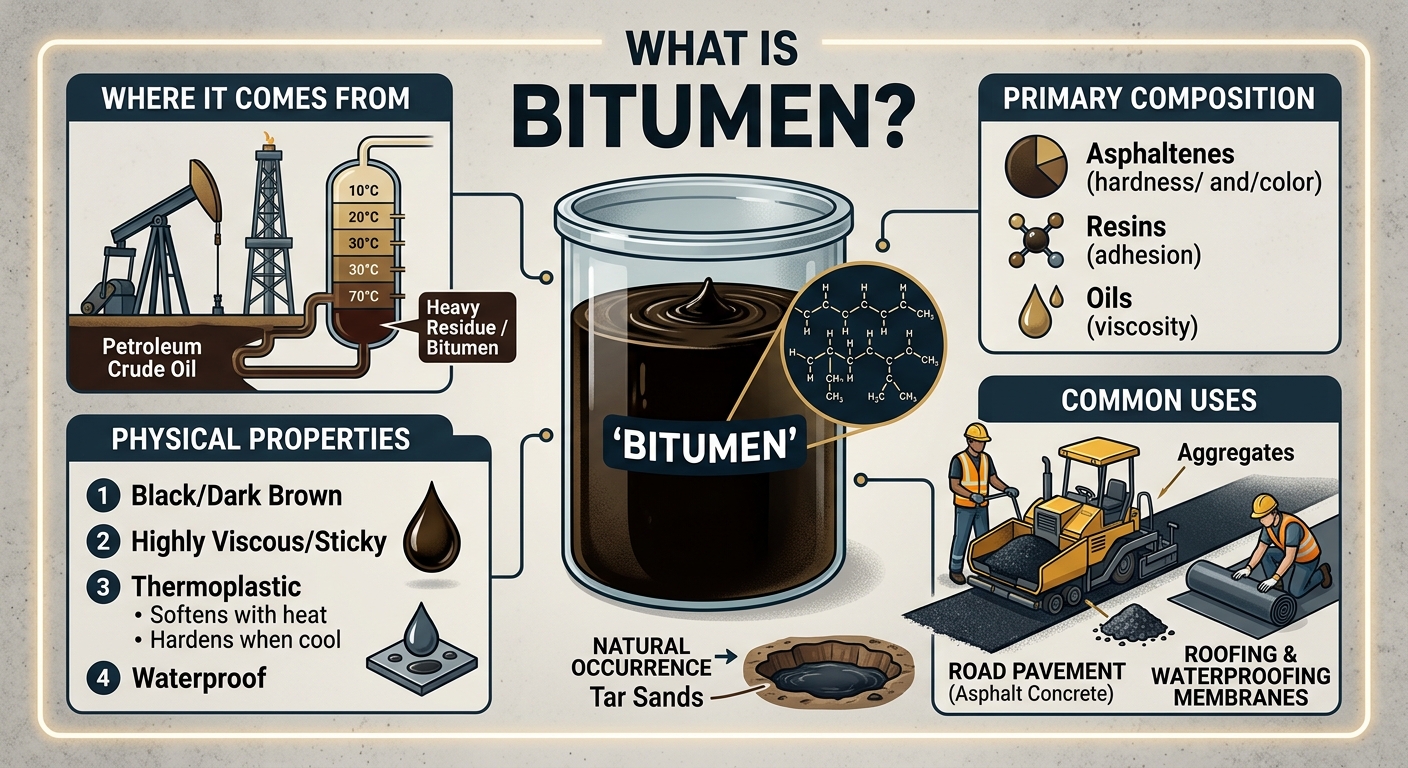
Bitumen is a black or dark-brown, highly viscous, sticky substance that occurs naturally or is produced as a by-product of crude oil refining. Chemically, it is a complex mixture of heavy hydrocarbons — primarily asphaltenes, resins, and oils — that give it its distinctive properties of adhesion, waterproofing, and viscoelasticity.
The European standard DIN EN 12597 defines bitumen as an "almost non-volatile, sticky, and sealing oil-based product that is extremely viscous or nearly solid at ambient temperatures." In simple terms: it's thick, it sticks, it seals, and it softens when heated.
Where Does Bitumen Come From?
There are two primary sources of bitumen:
- Natural bitumen — found in deposits around the world, most famously in the Athabasca oil sands of Alberta, Canada. Natural bitumen seeps to the surface in some regions and has been used by humans for thousands of years.
- Refined bitumen — the more common commercial source. It is produced during the fractional distillation of crude oil. The lighter fractions (petrol, diesel, kerosene) are removed first, leaving behind the heavy residual bitumen.
In Nigeria, for example, approximately 98% of bitumen is imported from overseas suppliers, since domestic refining capacity for the material remains limited.
Bitumen vs. Asphalt vs. Tar: What's the Difference?
These three terms are often used interchangeably, but they are not the same thing.
- Bitumen — the binder itself. A sticky, black hydrocarbon derived from crude oil.
- Asphalt — the finished paving mixture of bitumen and aggregates (crushed stone, gravel, sand). In some regions, "asphalt" is also used to refer to the binder itself.
- Tar — a completely different material produced from the destructive distillation of coal, wood, or other organic matter. Tar is not used in modern road construction due to health and environmental concerns.
Key Properties of Bitumen
Bitumen's usefulness comes down to a handful of unique properties:
- Adhesion — it bonds strongly to aggregates and other surfaces
- Waterproofing — it is virtually impermeable to water
- Viscoelasticity — it behaves like a solid at low temperatures and a viscous liquid at high temperatures
- Durability — it resists weathering and chemical attack
- Thermoplasticity — it can be softened, reshaped, and reheated repeatedly
How Is Bitumen Classified?
Not all bitumen is the same. Engineers classify it by grade to match specific climates and traffic conditions.
Penetration Grade
The oldest system, based on how far a standard needle penetrates a bitumen sample under controlled conditions. Common grades include 40/50, 60/70, and 80/100. Lower numbers indicate harder bitumen.
Viscosity Grade (VG)
Used in India and several other countries. The scale runs from VG10 (softest) to VG40 (hardest). VG30 is standard for most highways, while VG40 is used in high-stress areas like toll plazas and expressways.
Performance Grade (PG)
Developed under the U.S. Superpave program, this system specifies bitumen based on the pavement temperatures it will experience. A "PG 64-22" binder, for example, is designed to perform between -22°C and 64°C.
Types of Bitumen Products
Beyond the raw binder, bitumen is processed into several different product forms:
- Cutback bitumen — bitumen thinned with solvents like kerosene for easier application at lower temperatures
- Emulsion bitumen — bitumen dispersed in water with emulsifying agents, allowing cold application
- Polymer-modified bitumen (PMB) — bitumen blended with polymers (usually SBS or APP) for enhanced performance
- Oxidised bitumen — bitumen blown with air to increase hardness and reduce temperature susceptibility, used in roofing
What Is Bitumen Used For?
Bitumen's applications are far broader than most people realise:
- Road construction — approximately 85% of global bitumen consumption
- Roofing — about 10%, in shingles and waterproofing membranes
- Waterproofing — basements, foundations, pond liners, and canal lining
- Industrial coatings — protective layers for pipes and tanks
- Adhesives — pressure-sensitive bonding applications
- Railway infrastructure — trackbed stabilisation
Why Bitumen Matters
Bitumen is the backbone of modern infrastructure. Without it, there would be no motorways, no airport runways, no reliable waterproofing for buildings. Its unique combination of properties — adhesion, waterproofing, durability, and flexibility — has made it indispensable for over a century.
As the world looks toward more sustainable construction, bitumen is also evolving. Warm-mix technologies, recycled asphalt pavement (RAP), and bio-based binders are reducing the environmental footprint of this remarkable material while extending its useful life.
Whether you're a student, an engineer, or simply curious about the world around you, understanding bitumen is understanding the foundation of modern life.