
Uses Of Bitumen
September 13, 2026 · By Admin
The Many Uses of Bitumen: More Than Just Roads
Published on September 15, 2026 · 6 min read
When most people hear the word "bitumen," they picture a steaming black mix being poured onto a road surface. And they're not wrong — road construction is by far the largest consumer of this material. But bitumen's story goes much further.
This sticky, black, highly viscous substance derived from crude oil has been used by humans for thousands of years, and its applications today span far beyond the highway.
What Exactly Is Bitumen?
Bitumen is best understood as the heavy, viscous residue left after the more volatile components of crude oil have been removed through distillation. According to European standard DIN EN 12597, it's defined as an "almost non-volatile, sticky, and sealing oil-based product that is extremely viscous or nearly solid at ambient temperatures". Its most valuable properties — waterproofing, adhesion, and viscoelasticity — make it uniquely suited for a wide range of industrial applications.
The Dominant Use: Road Construction
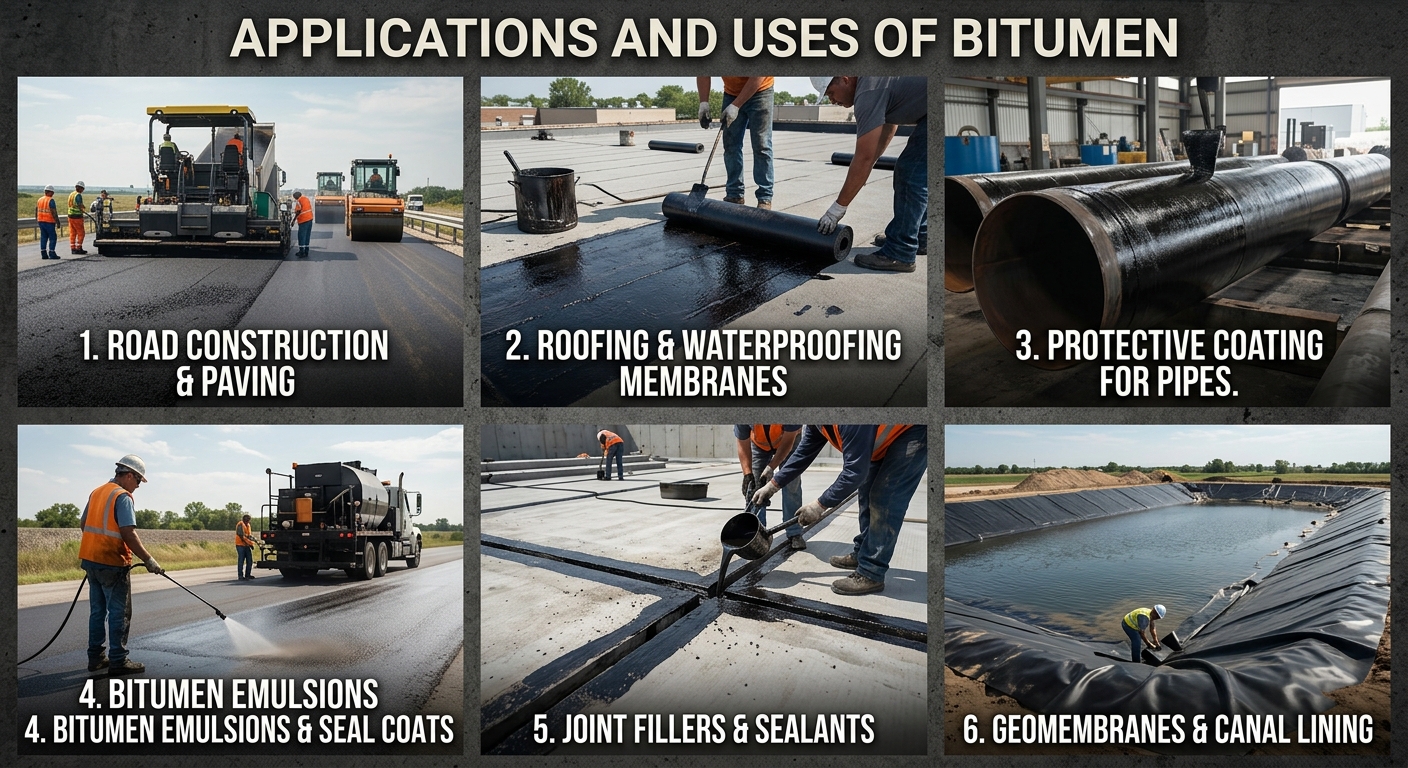
It's no exaggeration to say that roads are bitumen's primary purpose. Approximately 85% of all bitumen produced globally is used in road construction. When mixed with aggregates (crushed stone, gravel, and sand), bitumen acts as the binding agent that holds asphalt together, giving roads their strength, flexibility, and resistance to deformation.
But "road construction" is itself a broad category. Bitumen is used across multiple layers of a pavement structure, including:
- Surface courses — the top layer that directly bears traffic loads
- Base layers — providing structural support beneath the surface
- Subbases — the foundation layer above the subgrade
Bitumen also plays a critical role in airport runways and taxiways, where it must withstand the immense weight of aircraft under extreme temperature variations.
Understanding Bitumen Grades for Roads
Not all bitumen is the same. Engineers classify it by viscosity grades (VG) or performance grades (PG) to match the material to specific climates and traffic conditions.
The VG system, common in India and several other countries, ranges from VG10 (softest) to VG40 (hardest). VG30 is the workhorse grade for most highways, while VG40 is reserved for high-stress areas like toll plazas and expressways where rutting is a major concern.
The Performance Grade (PG) system, developed under the U.S. Superpave program, takes a more sophisticated approach by specifying bitumen based on the actual pavement temperatures it will experience. For example, a "PG 64-22" binder is designed to perform at pavement temperatures ranging from -22°C to 64°C.
Roofing and Waterproofing
After roads, roofing accounts for about 10% of bitumen consumption. Here, bitumen's waterproofing properties take center stage. Polymer-modified bitumen — typically blended with SBS (styrene-butadiene-styrene) or APP (atactic polypropylene) polymers — is used to manufacture roofing membranes, shingles, and felt that protect buildings from rain and moisture.
The waterproofing applications extend well beyond rooftops. Bituminous membranes are used for:
- Building basements and underground structures
- Pond liners and canal lining
- Geomembranes for waste disposal areas
- Damp-proof courses in masonry
Industrial and Specialty Applications
The remaining 5% of bitumen goes toward a surprising variety of specialized uses. Some of the more notable ones include:
- Bituminous paint and coatings — protective layers for pipes, tanks, and foundations
- Joint filling — sealing gaps in pavement and construction joints
- Tank foundations — creating impermeable bases for storage tanks
- Pressure-sensitive adhesives — bitumen-based adhesives are used in various industrial bonding applications
- Carpet backing — providing dimensional stability and moisture resistance
- Railway applications — trackbed stabilization and related infrastructure
The Role of Modified Bitumen
As demands on infrastructure have grown, so has the need for bitumen that performs beyond the capabilities of conventional grades. Polymer-modified bitumen (PMB) incorporates polymers — most commonly SBS — to dramatically improve performance. The benefits include:
- Greater resistance to rutting (permanent deformation under heavy loads)
- Better low-temperature flexibility to prevent thermal cracking
- Improved fatigue resistance for longer pavement life
- Enhanced adhesion between bitumen and aggregates
According to industry sources, using modified bitumen can double the useful lifespan of a roadway.
Bitumen Emulsions: A Greener Alternative
One of the practical challenges with bitumen is that it must be heated to very high temperatures (typically 150–170°C) to be workable. Bitumen emulsions solve this problem by dispersing bitumen in water with the help of emulsifying agents, creating a product that can be applied at much lower temperatures.
Emulsions are used for:
- Tack coats — the adhesive layer between pavement layers
- Surface treatments — sealing and protecting existing roads
- Cold asphalt mixes — paving in situations where hot mix isn't practical
This technology reduces energy consumption and emissions while maintaining the performance characteristics of the bitumen itself.
A Material That Keeps Giving
From the highways we drive on to the roofs over our heads, bitumen is one of those unassuming materials that quietly holds modern infrastructure together. Its unique combination of waterproofing, adhesion, and durability has made it indispensable for over a century — and with ongoing innovations in polymer modification and sustainable production methods, its role is likely to continue well into the future.
Whether you're a contractor specifying materials for a project or simply curious about the built environment around you, understanding bitumen's versatility offers a new appreciation for this remarkable petroleum product.